
Location-Based Page Titles Explained: Detailing, PPF and Tint Edition
Chris McCreery
November 5, 2026
If your shop sits just outside a major city, it's tempting to put that city's name front and center on your website. More people live there, more cars are on the road there, and it feels like a bigger headline should bring in bigger business.
County and Major Metropolitan
Mentions Misconceptions
In practice, it usually works the other way. Your website performs best when its headlines name the town your shop is actually in, because that's where Google already believes your business is. Your Google Business Profile, your address, and your online listings all point to that town, and your website wins the most when it tells Google the same story.
That doesn't mean you give up on customers from the city or the surrounding towns. It means each place gets the right job on your site.
Below, we'll walk through how Google decides which shops show up locally, why your town leads your headlines, and how we reach drivers from everywhere else in your service area.
How Google Decides
Which Detail Shops Show Up Locally
According to
Google Business Profile Help, local results are based mainly on three factors: relevance, distance, and prominence. Only one of those is something a website headline can influence.
| Factor | What Google Means | What Controls It |
|---|---|---|
| 🎯 Relevance | How well your business matches what someone searched for | Your services, your Google profile, and your website content |
| 🗺️ Distance | How far your shop is from the searcher, or from the town they typed | Your shop's actual address |
| 📣 Prominence | How well known your business is | Reviews, ratings, links, and listings across the web |
When someone searches without typing a town, Google uses their own location to judge distance. So the map results a shopper sees are shaped mostly by where your shop physically sits, and no wording on your website changes that. Google also states plainly that there is no way to request or pay for a better local ranking.
The takeaway: a city name in your headline does not move your pin on the map.
Why Your Town
Leads Your Headlines
Your page titles and main headlines (called H1s) are the strongest location signals on your website. We point them at your shop's town because every other signal Google sees already points there.

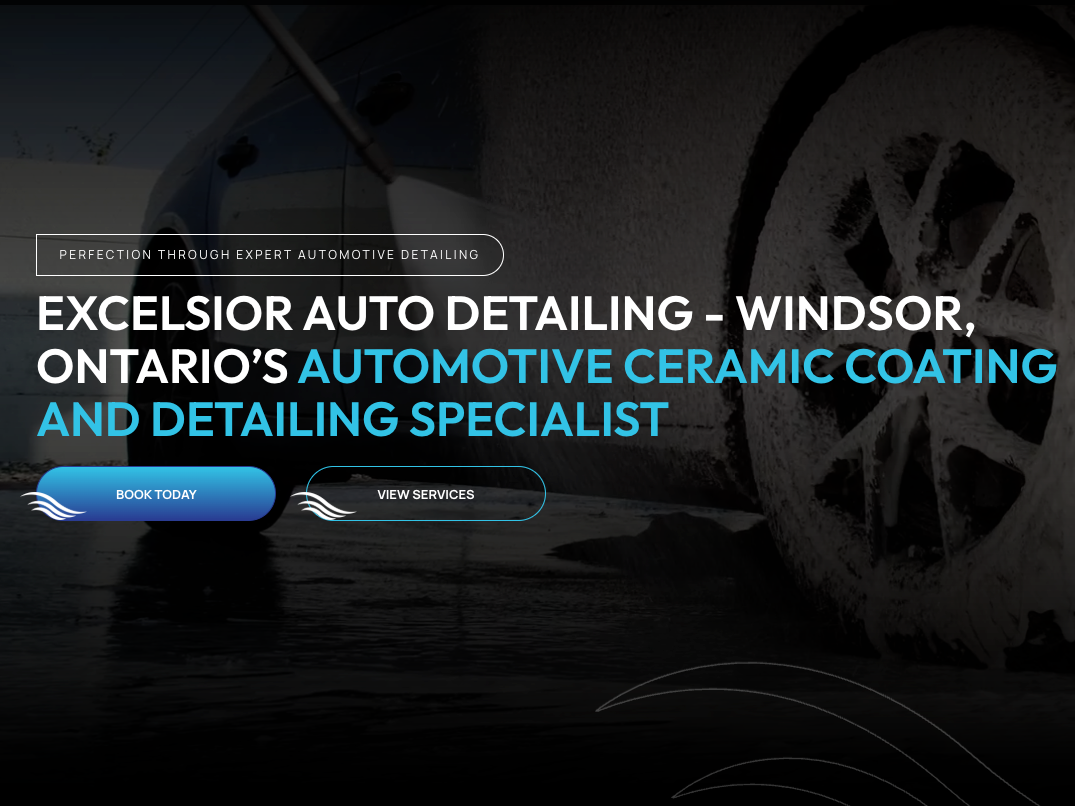
Examples of H1 headlines; Top Shine Detailing's website on the left, Excelsior Auto Detailing's website on the right
- It matches your Google profile. Your Business Profile, map pin, and address all name your town. When your website agrees, Google trusts the whole picture more.
- It matches your listings. Yelp, directories, and data providers list your shop under your town. Consistent information across the web is part of how Google judges prominence.
- It's honest with customers. A shopper who clicks a result for a big city and then finds an address 20 minutes away often feels misled and leaves.
- Big city searches are already spoken for. For a search like "ceramic coating [big city]," Google strongly favors shops with an address in that city. A headline can't compete with an address, so leading with the big city trades a signal that works for one that rarely does.
Where Your customers' Searches
Actually Come From
Here's the part most shop owners don't expect: the majority of people looking for a detailer never type a city name at all. They search "near me," or just the service, and Google fills in their location for them.
Search Phrase
Average Monthly Searches (US)
car detailing near me
ceramic coating near me
ceramic coating los angeles
car detailing spokane
car detailing post falls
136,000
25,000
200
200
50
Volumes are Ahrefs estimates. The "near me" figures are national totals, but the pattern holds in every market we check: searches that include a city name are a small slice compared to searches where Google uses the shopper's location.
That's why the town in your headline matters less than it seems, in either direction. Leading with a bigger city wouldn't unlock a flood of new searches, and leading with your own town doesn't shut anyone out. What wins "near me" searches is a strong Google profile, good reviews, and a website that confirms exactly where you are.
how We Reach Customers In Nearby Towns
Google ranks individual pages, not whole websites. So a town earns real visibility when it has a page built around it, not when its name is scattered across other pages. Every nearby town you serve gets a role on your site, matched to how much search demand it has.
| Where a Town Appears | What It Does |
|---|---|
| Its own neighborhood area page (NAP page) | Targets searches like "car detailing near [town]" with content written for drivers from that town |
| Page descriptions in Google results | Tells shoppers scanning results that you're close to them, which helps them click |
| Your service area section | Shows customers which towns you serve and links to each town's page |
| Your reviews | Reviews that mention a customer's town are some of the strongest proof you serve it |
We build neighborhood area pages for the towns where search numbers and your customer base support them, and we can add more over time. When Google starts showing your site for a town that doesn't have a page yet, that's our signal to build one.
Common Questions From Shop Owners
Why not use the big city nearby? More people live there.
More people do live there, but Google shows those people the shops that are physically in that city first. Your headline can't change your address, so leading with the big city puts you in a race you're set up to lose while weakening the signal you can win. We reach big city drivers more effectively with a dedicated page, especially for services people will drive farther for, like paint protection film and ceramic coating.
Most of my customers come from other towns. Shouldn't my headline reflect that?
That's common, and it doesn't change which town should lead your headlines. Those customers mostly find you through "near me" searches, your Google profile, and your reviews, and all of those depend on Google knowing exactly where your shop is. Your headlines confirm that location, while your town pages, page descriptions, and reviews reach drivers coming in from elsewhere. Tell us which towns your customers come from, because that's exactly what we use to decide which towns get their own pages.
A competitor uses the big city in their headlines. Why shouldn't we?
We check this when it comes up, and it rarely helps them. In a recent market we reviewed, a shop two miles from our client led its homepage title with the big city and still didn't appear in the top ten results for that city. Copying a competitor's headline doesn't copy their results.
Can we list every town we serve in the headline?
A headline crowded with towns reads poorly to customers, and Google treats it as a weaker signal than one clear location. Each town gets more value from its own page.
Can we switch the focus later?
Yes, if something real changes, such as opening a second location or moving. Switching without a change in address usually costs more than it gains, because it breaks the match between your website and your Google profile.
how You Can Help
Your Reach Grow
Your shop's location is fixed, but your reach isn't. These are the things that push your visibility farther out, and most of them are in your hands:
- Ask every customer for a Google review. Invite them to mention their car, the service, and the town they drove in from.
- Reply to every review, good or bad.
- Send us photos and stories from customers in nearby towns. Real local jobs make your town pages stronger than anything we can write on our own.
- Keep your Google profile current, including hours, services, photos, and regular posts.
- Tell us right away about any change to your address, phone number, hours, or business name, so your website and listings stay matched.
- Let us know where your customers come from. If you notice more customers from a particular town, that helps us decide which town page to build next.
The Bottom Line
Your town leads your headlines because that's where Google, your listings, and your customers already know you are. Nearby towns and the big city next door aren't ignored; they're reached through dedicated pages, page descriptions, reviews, and a strong Google profile, which is where those drivers actually find you.
Have a town you'd like us to target, or noticing more customers from somewhere new? Log in to the
Detailers Roadmap portal
and drop a comment on your site, or email our team at
support@8bitcreative.com. We'll take a look at the numbers and let you know which pages make sense to build next.

